Hacksaw Gaming
Le Bandit — Guide
A complete walkthrough of how Le Bandit by Hacksaw Gaming works — setting your bet, reading Golden Squares, the three bonus tiers, and the paytable.
Le Bandit’s whole engine turns on one unusual rule: when a cluster pays, every symbol of that type leaves the grid — not just the five or six that connected. Get that single mechanic straight and everything else — Golden Squares, coins, Clovers, the 10,000× ceiling — clicks into place. This page walks through the machine piece by piece, from the base grid up to the maths that makes the big wins possible.
The Grid: Cluster Pays, Not Paylines
Forget reels and paylines in the traditional sense. Le Bandit runs on a 6×5 grid — 6 columns, 5 rows, 30 positions total — and a win is any group of 5 or more matching symbols connected horizontally or vertically. Diagonals don’t count.
No line selector, no “ways to win” toggle, nothing to configure beyond your stake. That’s the point of cluster pays: your win potential comes from symbols clumping together anywhere on the grid, not from lining up on a fixed set of paths. A cluster in the top-left corner pays exactly the same as an identical cluster in the bottom-right.
Staking is single-value. Le Bandit doesn’t split bets into coin value and bet level — you pick one total stake between €0.10 and €100, and every payout in the paytable is expressed as a multiplier of that number. If the paytable shows a Gold coin worth 25×–500×, that’s 25×–500× of whatever sits in your bet field.
Autoplay and turbo are both present. The autospin menu lets you set a spin count plus stop conditions (loss limits, win limits, stop on feature trigger) depending on jurisdiction. Turbo compresses the cascade animations, which actually matters here — a long Super Cascade chain at normal speed can take ten seconds to fully resolve.
Super Cascade: Why the Whole Grid Empties
This is the mechanic that separates Le Bandit from a standard cluster-pays game, so the next stretch deserves a slow walk-through.
In most cluster games, a win removes only the connected symbols that formed it. Le Bandit does something more aggressive: once a cluster of 5+ pays, every copy of that symbol currently on the grid is removed — connected to the winning cluster or not. A low-pay symbol scattered across 14 unconnected positions, with just 6 of them forming a valid cluster, still sees all 20 symbols cleared in one cascade.
Fresh symbols drop to fill the gaps, which can trigger further clusters, which trigger further Super Cascades, and the chain continues until no new win forms. In practice this means a single spin can clear a large chunk of the grid before it settles — and every position cleared during that whole sequence becomes a Golden Square.
Worth knowing: heavily-weighted low-pay symbols aren’t dead weight in this game. A big low-pay cluster that also wipes a pile of stragglers elsewhere opens far more Golden Squares than a smaller high-pay cluster of the same connected size. Coverage, not cash value, is what a low-pay symbol is actually good for here.
Golden Squares: Building Coverage for the Payout
Every position emptied by a Super Cascade turns into a Golden Square and stays highlighted on the grid. These squares don’t pay anything by themselves — they’re potential, waiting to be activated.
Land a Rainbow anywhere on the grid and activation happens. The Rainbow pays nothing on its own; its only function is to detonate every Golden Square currently active, revealing what’s underneath each one.
Payout size is directly tied to how many Golden Squares are live when the Rainbow lands. A Rainbow arriving on a grid with 4 cleared positions is a rounding error. The same Rainbow on 20 Golden Squares is a session-defining spin. First time I saw a full grid of Golden Squares activate off a single Rainbow, I understood why this game has replay value. Whether Golden Squares persist across multiple spins (and for how long) depends on which bonus tier you’re in — more on that below.
The Coin Reveal: What’s Under a Golden Square
When a Rainbow triggers, each Golden Square reveals one of three things:
| Coin Type | Value Range |
|---|---|
| Bronze | 0.2× – 4× stake |
| Silver | 5× – 20× stake |
| Gold | 25× – 500× stake |
Two other reveals change how those values pay out:
- Four-Leaf Clover — applies a ×2 to ×10 multiplier to any coins adjacent to it. A Gold coin at 500× sitting next to a ×10 Clover is already 5,000× from a single position.
- Pot of Gold — collects the total value of every coin currently visible on the grid, multipliers included, and pays it as one lump sum.
Full chain, start to finish: cluster win → Super Cascade clears every copy → cleared positions become Golden Squares → cascades continue and coverage widens → Rainbow lands → coins reveal → Clovers multiply adjacent coins → Pot of Gold sweeps the total. Every feature tier below is really just a different setting on how long that pile is allowed to grow before it pays.
Scatter Triggers and the Three Bonus Tiers
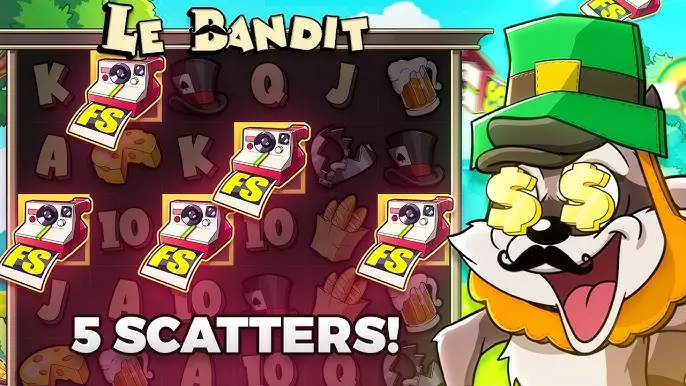
Scatter symbol here is a Polaroid camera — it doesn’t pay and doesn’t form clusters, it just counts. Land three or more on a resolved grid and you’re into free spins, with the tier determined entirely by how many landed.
3 scatters → Luck of the Bandit. 8 free spins. Golden Squares created during the round persist from spin to spin rather than resetting — coverage builds until a Rainbow lands, at which point every square reveals and pays, and the board resets to zero. Extra scatters during the round extend it: +2 spins for two more, +4 for three more.
4 scatters → All That Glitters Is Gold. 12 free spins, with a rule change that meaningfully raises the ceiling: Golden Squares persist and remain active after a Rainbow reveals them. They don’t clear. The first Rainbow might light 10 squares; the grid keeps building on top of that, and the second Rainbow hits those same 10 squares plus everything new. Each Rainbow lands on an increasingly dense board.
5 scatters → Treasure at the End of the Rainbow. 12 free spins with a guaranteed Rainbow on every single spin, and Bronze coins removed from the pool entirely — only Silver (5×–20×) and Gold (25×–500×) can appear. This is the primary route to the 10,000× maximum. It also cannot be purchased at any stake — organic scatters only.
Buy Feature — Brief Overview
Four purchase options exist where your operator allows them, letting you skip the wait for natural scatters:
| Feature | Cost | RTP |
|---|---|---|
| BonusHunt FeatureSpins | 3× stake | 96.28% |
| Rainbow FeatureSpins | 50× stake | 96.36% |
| Luck of the Bandit | 100× stake | 96.30% |
| All That Glitters Is Gold | 250× stake | 96.40% |
BonusHunt raises trigger probability roughly fivefold and puts the base game into a higher-volatility mode. Rainbow FeatureSpins guarantees a Rainbow on every base-game spin without buying a bonus round outright. The two named entries drop you straight into tier 1 or tier 2 free spins. Treasure at the End of the Rainbow has no buy option at any price — that one’s earned, not bought. Full cost-benefit breakdown of which buy suits which bankroll is on the bonus buy page; staking and session sizing generally is the strategy page’s territory.
RTP Variants — Check Before You Spin
Le Bandit ships in four RTP configurations: 96.34% (top), 94.23%, 92.17%, and 88.36%. Nothing on the reels or paytable screen tells you which one you’re playing — that information sits in the info panel’s final page, usually labeled “Theoretical return to player.” Check it before committing real money. That gap between 96.34% and 88.36% — nearly 8 percentage points — shows up in session length faster than most players expect.
Volatility is rated medium, hit frequency sits at 32.47% — roughly one paying spin in three — and the stated max win is 10,000× stake.
Quick Reference
Can I buy the 5-scatter bonus? No. Treasure at the End of the Rainbow is organic-only — no purchase route exists at any stake.
Do Golden Squares carry over between spins in the base game? They persist through a cascade chain within a single spin. Carrying over across multiple spins is a free-spins rule: tier 1 keeps them until a Rainbow fires, tier 2 keeps them even after.
Why did my cluster remove symbols from the other side of the grid? That’s the Super Cascade. Every copy of the winning symbol leaves, connected or not — it’s the core mechanic, not a bug.
Is the demo the same game? Yes. The free demo needs no registration and runs identical mechanics to real money, including all three bonus tiers. Ready for real stakes? Play Le Bandit here.