
Hacksaw Gaming
Le Bandit — Strategy
Le Bandit Slot Explained: RTP, Mechanics and Bonus Rounds for New Players
Le Bandit Screenshots
Understanding the Math
One spin in three pays something on Le Bandit — that’s the 32.47% hit frequency, and honestly it’s more useful for planning your session than the RTP figure. RTP tells you what happens over hundreds of thousands of spins. Hit frequency tells you what the next twenty minutes will feel like.
Flip that number around and roughly 67.5% of your spins return nothing. Run the math and a 10-spin dead streak has about a 2% chance of starting on any given spin. Across a 500-spin session, expect around ten of those stretches. A 15-spin blank sits near 0.28% — you’ll see one every few sessions. A 20-spin drought is closer to 1 in 2,500 spins, rare but far from impossible over a few weeks of play. None of that means the game has gone “cold.” It’s just what a one-in-three hit rate looks like sampled in small chunks.
RTP operates on a completely different timescale. 96.34% is the return over a huge sample, not your session. At €1 stakes across 500 spins, theoretical loss sits around €18 — but the actual spread around that number is wide enough that €18 is one of the least likely outcomes you’ll actually get. Real sessions cluster into three shapes: lost most of it, roughly flat, or one feature that paid for the whole night.
Here’s the part that takes 30 seconds and actually matters: check which RTP build you’re playing before depositing. Le Bandit ships in four versions, and the operator picks one.
| RTP setting | Return per €100 | Verdict |
|---|---|---|
| 96.34% | €96.34 | ✅ Best available |
| 94.23% | €94.23 | Below average |
| 92.17% | €92.17 | ⚠️ Poor |
| 88.36% | €88.36 | ❌ Avoid |
Nearly eight points separate best from worst. On €2,000 of turnover that’s a €160 difference in expected cost — real money for a glance at the info panel. That gap between 96.34% and 88.36% shows up in how long your session lasts faster than most players expect.
Medium volatility is the other half of this. It doesn’t mean tame — small cluster wins land often enough to fund the wait, while the ceiling still runs to 10,000×. Treat that top prize as a lottery outcome reachable almost exclusively through the tier-3 bonus. Budget as if your best realistic outcome is a strong tier-1 or tier-2 round, because that’s what usually happens.
Bankroll Management for Le Bandit
Bet range runs €0.10 to €100, wide enough that stake selection matters more than any other single decision you’ll make on this game.
Work backwards from your bankroll, not from the stake you’d like to play. Medium volatility with a 32.47% hit rate needs a buffer that survives repeated 10–15 spin dry patches, plus the gap before an organic bonus trigger shows up.
Volatility buffer, three levels:
- 100× bet — the absolute floor. €100 at €1 stakes, roughly 100–150 spins with small wins recycling through your balance. Fine for a short session; not enough to reliably reach a bonus round.
- 250× bet — the sensible working number. €250 at €1 absorbs a rough opening 50 spins without forcing you to cut stake, and gives the features a real chance to show up.
- 500× bet — what you need if you’re specifically hunting Treasure at the End of the Rainbow through natural play. Five scatters is rare and can’t be bought, so spin volume is the only tool you have.
If you’ve brought €50, your stake is €0.20 — not €1. Bring €500, and €1–€2 is comfortable. The pull with cluster slots is to raise stake because the small hits feel constant. Resist it. Those hits recycle your balance; they don’t grow it.
Stop-loss and take-profit for this game:
Set stop-loss at 50% of session bankroll — around 125× bet on a 250× roll. That’s the line where medium volatility has genuinely turned against you, and playing past it means chasing. Decide this before the first spin, not during a rough patch.
Take-profit is where most players give back money they’d already banked. On a medium-volatility cluster game, +70% of starting bankroll is a solid stopping point — cash it out, or withdraw half and continue on the rest. If a single bonus round pays 300× or more, call the session done. Those results don’t repeat to order, and playing on with a hot balance just feeds it back into a game with a 96.34% ceiling.
One more rule worth building in: the 40% mid-session floor. Down 40% with no bonus in sight? Drop stake one level instead of walking away. You extend your spin count without adding risk — exactly the trade you want once the buffer starts thinning.
Feature Targeting Strategy
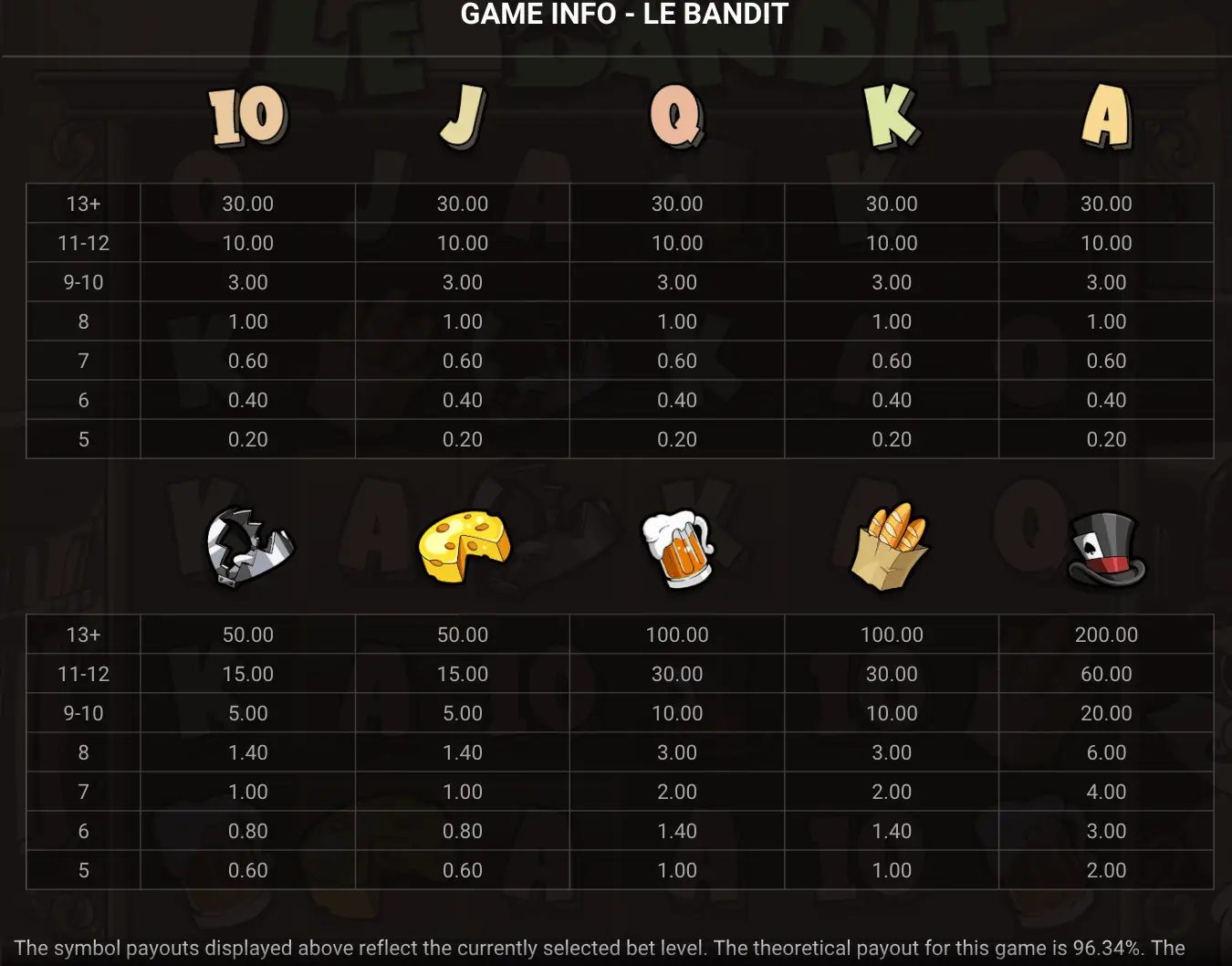
Three scatter-triggered rounds, three different staking implications. Full mechanics live in the Le Bandit game guide — here’s what each one means for your stake.
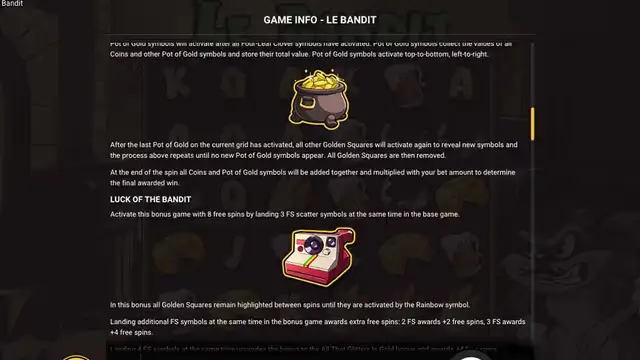
Luck of the Bandit (3 Polaroid scatters, 8 free spins). Golden Squares persist until a Rainbow activates them. The first time I saw a full grid of Golden Squares activate off a single Rainbow, I understood why this game has replay value. Eight spins is short, so this round hinges on whether a Rainbow lands late, on a well-stacked grid. Staking implication: you’ll see this one regularly, but it’s rarely a session-maker. Size your stake so hitting it feels like a bonus, not a bailout. Extra scatters help — 2 add 2 spins, 3 add 4 — but don’t plan around them landing.
All That Glitters Is Gold (4 scatters, 12 free spins). Squares stay active after Rainbow reveals, so each following Rainbow lands on a denser grid. This is a real step up, not a minor bump. Staking implication: if this is your target, you need spin volume — four scatters is meaningfully rarer than three. That argues for the smallest stake your bankroll can sustain over the longest possible session, rather than a few big-stake spins hoping to get lucky.
Treasure at the End of the Rainbow (5 scatters, 12 free spins). Guaranteed Rainbow on every spin, Bronze coins stripped out so only Silver (5×–20×) and Gold (25×–500×) remain. This is the road to 10,000×, and it cannot be purchased at any price.
That last detail shapes the whole approach. If tier-3 is your goal, turnover is the only lever you have. Divide your bankroll by 500 and play that stake — not the one that feels satisfying. Hacksaw doesn’t publish trigger frequencies, so plan conservatively: assume several hundred spins between organic bonus triggers and size your roll accordingly. If your bankroll only covers 150 spins, tier-3 isn’t a realistic target for this session — play for base-game cascade value instead.
A diagnostic worth watching — active cycle vs. dry run. There’s no predictive edge here, but there are patterns worth reacting to. An active cycle shows up as frequent multi-step cascades — a win clears a symbol type, drops, and reforms two or three times, stacking Golden Squares before the Rainbow arrives. A dry run looks like single-step wins with no follow-on clears, and Rainbows landing on near-empty grids. That second pattern is the one to act on — and the correct reaction is cutting stake to preserve spins, not raising it to chase.
Buy options sit at 3×, 50×, 100× and 250× stake, covered in full on the bonus buy page. The one rule that belongs here: no single buy should exceed 25% of your session bankroll.
Bet Sizing Approaches
Flat betting is what the math actually supports. Le Bandit’s RNG has no memory — raising stakes after a loss increases variance without touching expected value. You just hit your stop-loss faster. Every progression system does the same thing dressed up differently.
The one adjustment that genuinely helps runs the other direction: cutting stake when your bankroll shrinks stretches your remaining balance into more spins. Dropping from €1 to €0.50 at the 40% mark doubles your remaining spin count at the cost of halving potential returns — a fair trade when survival to a feature is the actual goal.
| Stake level | Bet range | Bankroll needed (250×) | Realistic session shape |
|---|---|---|---|
| Small | €0.10–€0.40 | €25–€100 | 400–800 spins. Best odds of seeing multiple bonus rounds. Wins feel modest but variance is survivable. |
| Medium | €0.50–€2 | €125–€500 | 200–400 spins. The balance point — one strong tier-2 round can define the whole session. |
| Large | €5–€100 | €1,250–€25,000 | 100–200 spins if properly funded. Swings get brutal; without the full buffer you’ll usually bust before a bonus arrives. |
Most players who lose faster than expected here aren’t unlucky — they’re playing the medium column on a small-column bankroll.
Session Management
Set two limits before you spin: money and time. Cascades can stretch a single spin past thirty seconds, which throws off your sense of pace — the session feels shorter than the turnover actually is.
A simple check, run every 100 spins:
- Up 70% or more? Stop, or withdraw half.
- Down 40% with no bonus yet? Drop one stake level.
- Down 50%? Session’s over. No exceptions, no “one more spin.”
- Roughly flat after 200 spins? That’s a completely normal outcome at 32.47% hit frequency. No decision needed.
Cap sessions at 45–60 minutes. Decision fatigue is real, and the moves that wreck bankrolls — raising stake after a dry spell, buying a feature you can’t afford — almost always happen after the first hour. Want to test the pacing without spending anything? The free demo runs identical mechanics with no registration required.
What Strategy Actually Does Here
Le Bandit runs on a certified RNG. Nothing in this guide improves your odds of winning — bankroll sizing, stop-losses and stake discipline change how long you last and how much you risk, not what the game pays back. The 96.34% figure means the house holds its edge on every single spin, regardless of how carefully you bet.
Decide your budget before opening the game. Treat it as entertainment spending you’re fine losing, and never fund a session with money earmarked for something else. Use deposit limits, loss limits and time reminders if your operator offers them. If you’re chasing losses, playing to fix a bad mood, or hiding what you’re spending — stop, and use the self-exclusion tools available to you.
Ready to play with a plan in place? Le Bandit is available here — check the RTP in the info panel first.
Frequently Asked Questions
There is no single correct answer — it depends on your session bankroll. A practical rule for Le Bandit's medium volatility is to keep each bet at 0.5–1% of your total session budget. For a €100 session that means €0.50–€1.00 per spin, giving you 100–200 spins before variance runs out — enough to realistically see a bonus trigger.
No. Le Bandit uses a certified RNG, meaning every spin is independent. The Polaroid scatter that triggers each bonus round has no memory of previous spins — neither timing, nor previous scatter appearances, nor session length affects the next result. Any tool or system claiming to predict triggers is misleading.
It depends on bankroll size. The 100× buy (Luck of the Bandit) and 250× buy (All That Glitters Is Gold) both have RTPs within 0.1% of the base game, so there is no meaningful RTP advantage. The value is reduced variance — you enter the feature immediately rather than waiting. Only use Bonus Buy if your session budget comfortably covers the cost without it representing the bulk of your bankroll.
No strategy changes the RTP or the RNG outcome. What bankroll management does is control how long you stay inside the math — sizing bets sensibly relative to your session budget gives the hit frequency (32.47%) time to work, rather than busting out before a bonus can trigger. That is the only real edge strategy provides on any certified RNG slot.